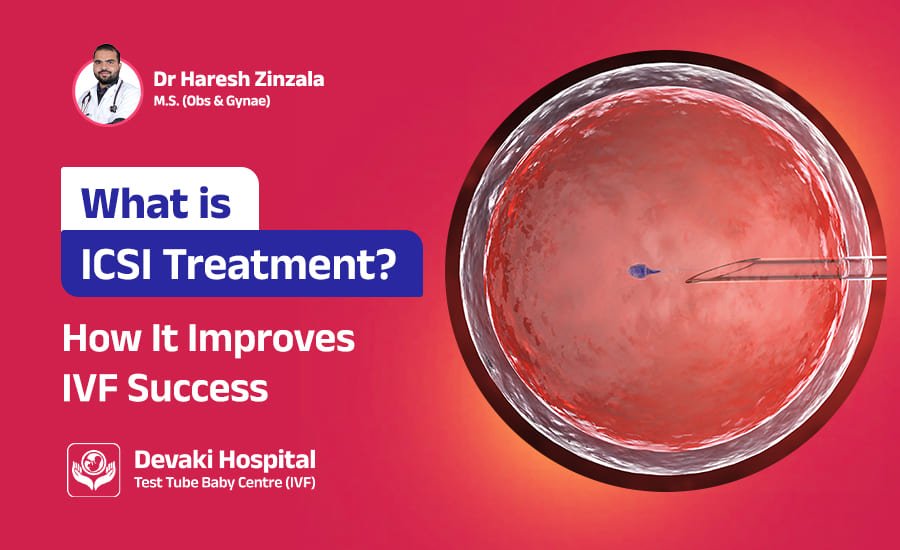
Many couples dream of having a baby, but sometimes getting pregnant is not easy. Fertility problems can happen to both men and women. The good news is that modern medical treatments can help many couples become parents. One of these advanced methods is ICSI Treatment, which is often used along with IVF. This treatment helps fertilize an egg by injecting a single healthy sperm directly into it. At Devaki IVF Centre in Surat, expert doctors help couples have babies. They use special technology, like ICSI, to greatly improve the chances of getting pregnant. With the right care and treatment, many families are able to welcome a healthy baby.
What is ICSI Treatment?
ICSI Treatment stands for Intracytoplasmic Sperm Injection. It is a medical procedure used to help couples who are having trouble getting pregnant.
In this treatment, doctors take one healthy sperm and inject it directly into an egg in a laboratory. This helps the egg get fertilized more easily.
How Does ICSI Treatment Work?
ICSI Treatment is a special step used during IVF to help an egg and sperm join together. Here is how the process works in simple steps:
1. Ovaries Are Stimulated
The woman takes medicines that help the ovaries produce several eggs instead of just one.
2. Eggs Are Collected
Doctors collect the mature eggs from the ovaries using a small medical procedure.
3. Sperm Sample Is Collected
A sperm sample is taken from the male partner. The healthiest sperm are selected in the lab.
4. Sperm Is Injected Into the Egg
A specialist uses a very fine needle to inject one healthy sperm directly into an egg.
5. Fertilization Happens
If the egg and sperm join successfully, they form an embryo.
6. Embryo Is Placed in the Uterus
After a few days, the doctor places the healthy embryo into the uterus so pregnancy can begin.
![🧩 FIND THE Missing Puzzle OF YOUR LIFE 👶
Sometimes, all your dream of becoming parents needs is the right diagnosis and the right treatment.
If you've been trying to conceive without success, don't lose hope. At Devaki IVF Centre, our fertility experts help identify the missing piece of your parenthood journey with advanced fertility evaluation and personalized IVF care.
Every puzzle has a solution. Let us help you complete yours.
📞 Call/WhatsApp: +91 90163 57992
🌐 Online Appointment: www.devakiivf.com
#DevakiIVF #FertilityCare #IVFJourney #IVFTreatment #Surat
[ IVF treatment, fertility clinic Surat, IVF Surat, infertility treatment, fertility specialist, parenthood journey, pregnancy planning, IVF consultation, test tube baby, Devaki IVF Centre ]](https://devakiivf.com/wp-content/plugins/instagram-feed/img/placeholder.png "What is ICSI Treatment? How It Improves IVF Success 1")
Why is ICSI Treatment Used?
Doctors use ICSI Treatment when it is hard for the sperm to fertilize the egg naturally during IVF. This treatment is often recommended in situations such as:
- Low sperm count – When there are very few sperm available.
- Weak sperm movement – When sperm cannot swim well to reach the egg.
- Abnormal sperm shape – When sperm are not shaped properly.
- Previous IVF failure – When fertilization did not happen in earlier IVF cycles.
- Blocked sperm flow – When sperm cannot come out normally and need to be collected by a doctor.
- Use of frozen sperm – When sperm have been frozen and stored earlier.
How ICSI Treatment Improves IVF Success
ICSI Treatment helps increase the chances of success during IVF. It is especially helpful when there are problems with the sperm. Here are some simple ways ICSI improves IVF success:
1. Higher Chance of Fertilization
Since the sperm is placed directly inside the egg, the chances of fertilization are higher.
2. Helps in Male Infertility
ICSI is very helpful when the sperm count is low or the sperm cannot move properly.
3. Reduces Fertilization Failure
In some IVF cycles, eggs may not get fertilized naturally. ICSI helps prevent this problem.
4. Better Use of Eggs
Each egg has a better chance of becoming an embryo, which improves the overall IVF results.
5. Helpful in Previous IVF Failures
Couples who had unsuccessful IVF cycles before may have better success with ICSI.
What is the Success Rate of ICSI Treatment?
ICSI treatment works best when some important things are healthy. These include the woman’s age, the quality of her eggs, the health of the sperm, and the experience of the fertility clinic.
In many cases, about 70% to 85% of eggs become fertilized with ICSI. This means that most of the eggs that doctors inject with sperm can start growing into embryos.
Conclusion
ICSI Treatment is an advanced fertility method that helps many couples who are facing problems in having a baby. In this treatment, a single healthy sperm is directly injected into an egg to help fertilization happen. Devaki IVF Centre provides safe ICSI treatment. Experienced doctors use modern technology and careful monitoring to help patients.